MEDIA
Politics and Portfolios: Keeping Perspective Through the 2026 Midterms
With Election Day on November 3, political headlines are hard to avoid. Polls shift, individual races tighten, and investors naturally ask what a change in control of Congress could mean for their portfolios.
The election matters. But history suggests politics and portfolio strategy should remain separate decisions.
Where the race stands
The national environment currently favors Democrats. As of October 24, the Call the Map polling average shows Democrats leading the generic congressional ballot by 7.7 points, with its broader national environment measure at D+8.4. That backdrop has strengthened expectations that Democrats could regain the House.
The Senate is far less predictable. Several decisive races remain close. The same averages show Democrats ahead by just 0.3 points in Iowa and 2.4 points in Michigan, a reminder that a small shift in voter sentiment could decide control of the chamber.
For investors, the goal is not predicting the outcome. It is recognizing that political uncertainty does not have to become investment uncertainty.
Elections matter, but fundamentals matter more
Control of Congress can shape taxes, government spending, regulation and trade policy. Those decisions can have real implications for specific industries, companies and households.
But elections are one variable among many. At any given time, markets are weighing:
- Economic growth
- Corporate earnings
- Inflation and interest rates
- Valuations
That is one reason election results have not provided a dependable market timing signal.
It is also worth keeping the stakes in perspective. Whether Democrats win one chamber or both, the President retains his veto, most legislation still needs 60 votes in the Senate, and many of the policies that have shaped markets this year, including tariffs, deregulation and export controls, rest on executive authority that does not depend on who controls Congress. The more likely outcome is greater oversight and more gridlock, not a sharp turn in policy.
History offers an interesting illustration. Since 1950, the S&P 500 has averaged a one year price return of roughly 15.4% following midterm elections, compared with 7.8% in other years. But averages are not guarantees, and academic research suggests much of that post midterm advantage fades once returns are adjusted for risk.
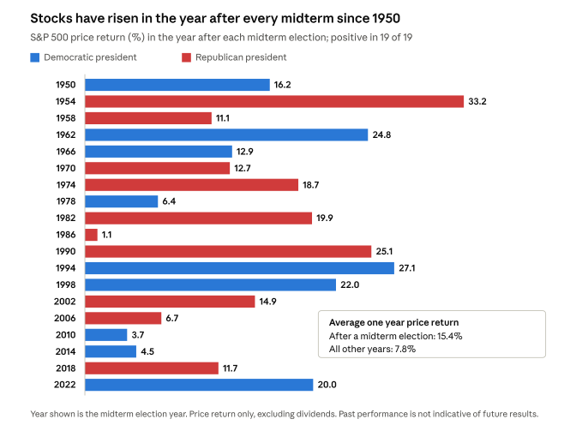
Source: PIMCO, Bloomberg, Standard & Poor’s, as of January 15, 2026 · S&P 500 price return measured from Election Day in midterm years (1950 to 2022) and from November 5 in all other years
An interesting historical pattern is not the same as an investment strategy.
Invest your plan, not your politics
The bigger risk may be letting political preferences drive investment decisions.
Everyone has views on elections. But markets have operated through Republican, Democratic and divided governments, and businesses have continued to innovate, earn profits and adapt to new policies.
For most families, the investment horizon extends well beyond a single election. Retirement, legacy, philanthropic and multigenerational goals can span decades, with many elections and policy regimes along the way.
That is why we believe the better approach is to stay focused on what you can control:
- Diversification
- Appropriate risk management
- Tax aware planning
- A portfolio aligned with your long term objectives
Stay informed. Vote your convictions. But when it comes to your portfolio, let your financial plan, not your politics, lead the way.
Please reach out to your advisor with any questions.
Polling figures are averages as of October 24, 2026 and are not forecasts. Past performance is not indicative of future results.
Read More
Market Commentary|Mar 2026
Market Perspective: Navigating Private Credit Headlines and Interval Fund…
Market Commentary|Nov 2023